H2O To GO

Best Water Softener & Reverse Osmosis Systems in Las Vegas

Phone Estimates
702-367-2100
  • 0
  • Home
  • Products
    • Drinking Water Systems
    • Whole House Systems
      • Water Refiners
      • Water Conditioners
      • Water Softeners
      • Salt Free Water Treatment
    • Light Commercial
    • Replacement Filter Cartridges
    • Water Softener Salt
  • Services
    • Water Systems Repairs
    • Water Softener Installation
    • Salt Delivery Service
    • Rental Systems
    • Free Water Test
  • Resources
    • Manuals & Instructions
    • Frequently Asked Questions
  • Benefits
    • What Are The Benefits Of Drinking High PH Water
    • Las Vegas Water Purification Systems
    • Best Under Sink Water Filter
    • Better Than Buying Bottled Water at your Local Groceries in Las Vegas NV
    • Plumbing and Appliance Savings with Home Water System from H2O to Go Las Vegas
    • Clean and Healthy Drinking Water from H2OtoGo’s Water Purification Systems in Las Vegas NV
    • Enjoy Healthier Hair and Skin with our Water System – H2OtoGo Las Vegas
    • Water Tastes Better with H2O to Go, a Las Vegas Water Purification System Company
    • Save Big on Detergent and Cleaning Product with our Home Water System in Las Vegas NV
    • No More Hard Water Spots in your Home in Las Vegas with our Water Systems
    • Whiter, Brighter, Longer Lasting Fabrics with H2OtoGo’s Home Water System in Las Vegas NV
  • Contact
  • Request Call Back
  • About
    • Reviews
    • Services Locations
      • HENDERSON, NV
      • NORTH LAS VEGAS, NV
      • SUMMERLIN, NV
      • ENTERPRISE, NV
    • H2O to GO’s Referral Program

Frequently Asked Questions

Answers to questions about water softeners, reverse osmosis systems, water filters and hard water for Las Vegas, Henderson, North Las Vegas, Summerlin and Enterprise.

April 7, 2026 by Bill Bacon

What’s The Chemical Reaction Behind Hard Water Scale

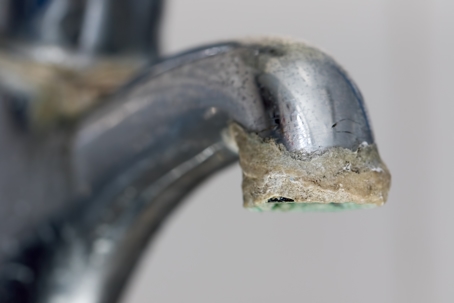
One of the biggest problems caused by hard water is scale buildup, also called limescale. This white, chalky material forms when dissolved minerals in water go through a chemical reaction that turns them into solid deposits.

Understanding the chemistry behind this process helps explain why hard water causes buildup in pipes, appliances, and fixtures throughout homes in places like Las Vegas, where water hardness is very high.


Dissolved Minerals in Hard Water

Hard water contains dissolved minerals, mainly:

• Calcium (Ca²⁺)
• Magnesium (Mg²⁺)

In natural water systems, these minerals often exist in the form of calcium bicarbonate and magnesium bicarbonate.

These compounds stay dissolved in water under normal conditions, meaning the water can carry them through plumbing systems without immediately forming deposits.


What Happens When Water Is Heated

When hard water is heated—such as inside a water heater, dishwasher, or coffee maker—a chemical reaction occurs.

Calcium bicarbonate breaks down into three components:

  • Calcium carbonate (solid scale)
  • Carbon dioxide gas
  • Water

The chemical reaction looks like this:

Ca(HCO₃)₂ → CaCO₃ + CO₂ + H₂O

Calcium carbonate (CaCO₃) is the white, solid material that forms limescale deposits.


Why Scale Sticks to Surfaces

Calcium carbonate is not very soluble in water, especially at higher temperatures. When the reaction occurs, the calcium carbonate crystals begin attaching themselves to nearby surfaces such as:

• heating elements
• pipes
• faucet aerators
• dishwashers
• shower heads

Once the first layer forms, additional minerals easily attach to the existing buildup, gradually creating thicker deposits.


Why Heat Accelerates Scale Formation

Heating water speeds up scale formation for two main reasons:

1️⃣ Reduced gas solubility – When water is heated, carbon dioxide escapes more easily. This pushes the chemical reaction toward forming solid calcium carbonate.

2️⃣ Faster precipitation – Higher temperatures make it easier for dissolved minerals to crystallize into solid form.

This is why scale forms fastest in:

• water heaters
• coffee machines
• dishwashers
• tankless water heaters


Why Las Vegas Homes See Heavy Scale

Las Vegas water commonly measures 15–18 grains per gallon, which means there is a high concentration of calcium and magnesium available to form scale.

Over time, this can lead to:

• thick mineral buildup on fixtures
• clogged shower heads
• reduced water heater efficiency
• restricted plumbing pipes

Even a thin layer of scale inside a water heater can significantly reduce heat transfer efficiency.


How Water Softeners Prevent the Reaction

Water softeners remove calcium and magnesium ions before the water enters your plumbing system.

They do this using ion exchange, where hardness minerals are replaced with sodium or potassium ions.

Without calcium and magnesium present, the chemical reaction that produces calcium carbonate cannot occur, which prevents scale from forming in the first place.


Why This Matters for Homeowners

Understanding the chemistry behind scale explains why hard water problems are so persistent in regions with high mineral content.

Preventing scale formation can help:

• extend appliance lifespan
• maintain water heater efficiency
• reduce plumbing maintenance
• keep fixtures looking clean

For many homes in Southern Nevada, water treatment systems are one of the most effective ways to manage the long-term effects of hard water chemistry.


Filed Under: Frequently Asked Questions

April 5, 2026 by Bill Bacon

What Is The Science Behind Water Hardness

Image

Water hardness is a scientific term used to describe the amount of dissolved minerals in water, primarily calcium and magnesium. These minerals are naturally picked up as water travels through rock and soil before reaching reservoirs, wells, and municipal water systems.

In areas like Las Vegas, water travels long distances through mineral-rich geological formations before it reaches homes. As a result, it absorbs significant amounts of calcium and magnesium, which is why Southern Nevada is known for having very hard water.

Understanding the science behind water hardness can help homeowners see why mineral buildup occurs and why water treatment systems are so common in the region.


How Water Becomes Hard

Rainwater starts out relatively pure. As it falls to the ground and flows through soil and underground rock layers, it dissolves small amounts of minerals.

Two of the most common minerals are:

• Calcium
• Magnesium

These minerals come from rocks such as:

• limestone
• chalk
• gypsum

When water dissolves these minerals, they remain in the water as dissolved ions. The higher the concentration of these ions, the harder the water becomes.


How Water Hardness Is Measured

Water hardness is typically measured using two common units:

Grains per gallon (GPG)
or
Parts per million (PPM)

Both measurements represent the concentration of dissolved minerals.

Typical hardness levels look like this:

Hardness LevelGPGPPM
Soft water0–30–50
Moderately hard3–750–120
Hard7–10120–180
Very hard10+180+

Las Vegas water often measures 15–18 grains per gallon, which falls firmly into the very hard water category.


Why Hard Water Creates Scale

When hard water is heated or evaporates, the dissolved minerals can come out of solution and form solid deposits.

This process creates scale, also known as limescale.

Scale commonly appears on:

• faucets
• shower doors
• kettles
• coffee makers
• water heaters

Inside pipes and appliances, scale buildup can reduce efficiency and restrict water flow.


Chemical Reaction Behind Scale

One of the most common forms of scale is calcium carbonate.

When calcium bicarbonate in water is heated, it breaks down into calcium carbonate, carbon dioxide, and water.

This reaction leaves behind the familiar white mineral deposits seen in many Las Vegas homes.


Why Hard Water Affects Soap

Hard water also reacts with soap. Calcium and magnesium ions bind with soap molecules and form an insoluble substance commonly called soap scum.

Instead of dissolving completely, soap forms a sticky residue that can stick to:

• sinks
• bathtubs
• skin
• fabrics

This is why soap often doesn’t lather well in hard water and why more detergent is needed for cleaning.


How Water Softeners Solve the Problem

Water softeners use a process called ion exchange. Inside the softener tank are tiny resin beads that hold sodium or potassium ions.

As hard water passes through the resin:

• calcium ions are captured
• magnesium ions are captured
• sodium ions are released into the water

This exchange removes the hardness minerals and produces soft water throughout the home.

Soft water helps prevent scale buildup, improves soap performance, and can extend the life of plumbing and appliances.


Why Water Hardness Matters in Las Vegas

Because Southern Nevada has such high mineral content in its water supply, many homeowners experience common hard water problems like:

• scale buildup on fixtures
• cloudy dishes
• dry skin and hair
• reduced appliance efficiency

Understanding the science behind water hardness helps explain why water softeners and filtration systems are so widely used throughout the Las Vegas valley.

For homeowners dealing with these issues, water treatment solutions can make a significant difference in both water quality and home maintenance.

Filed Under: Frequently Asked Questions Tagged With: water softeners

February 14, 2026 by Bill Bacon

How long does water softening resin last in Las Vegas

Typical Lifespan in General

  • Under normal conditions, water softener resin typically lasts 10–15 years.

In Las Vegas

Las Vegas has some of the hardest municipal water in the U.S., with hardness often exceeding 250–300 ppm (15–20 grains per gallon).
Because of this:

  • Resin lifespan is usually shorter: around 7–10 years for standard ion-exchange resin.
  • The high calcium, magnesium, and silica content causes more rapid fouling and iron buildup, especially if not periodically cleaned.

Factors That Affect Lifespan

  1. Water Hardness & Chlorine Levels
    Las Vegas water has high chlorine content, which oxidizes and degrades resin beads over time.
    → Consider a carbon pre-filter to remove chlorine before the softener.
  2. Regeneration Frequency
    If your softener regenerates very often (daily or every other day), resin wear accelerates.
  3. Maintenance & Cleaning
    Regular use of a resin cleaner, such as citric acid or Iron-Out-type products every few months, can help extend life.
  4. Type of Resin
    • Standard (8% crosslink): Lasts about 7–10 years in Las Vegas.
    • High-Capacity (10% crosslink): More chlorine-resistant, can last 10–15 years even in harsh conditions.

Signs It May Be Time to Replace

  • Noticeably harder water despite enough salt in the brine tank
  • Increased water spots or soap scum
  • Softener regenerates more often or ineffectively
  • You hear resin beads in your plumbing or see them in faucet aerators

Recommendations

  • Use a chlorine-removal stage before your softener.
  • Choose 10% crosslink resin when replacing.
  • Schedule a professional resin bed inspection every 5 years.

Filed Under: Frequently Asked Questions, Water Softener Henderson, Water Softener Las Vegas, Water Softeners Tagged With: water softeners

February 7, 2026 by Bill Bacon

What Kind of Salt Should I Use in a Water Softener?

If you own a water softener, the type of salt you use matters more than most people realize. Using the wrong salt can reduce efficiency, cause salt bridging, or even shorten the life of your system. Using the right salt keeps your softener running clean, efficient, and problem-free.

Here’s a breakdown of the most common water softener salts—and which one is best for your home.


1. Solar Salt

Best overall choice for most homes

Solar salt is made by evaporating seawater and is available in pellets or crystals. It’s one of the most popular options because it’s affordable and works well in most water softeners.

Pros:

  • Widely available
  • Budget-friendly
  • Works well with most systems

Cons:

  • Can contain small amounts of sediment
  • May require occasional cleaning of the brine tank

Best for: Homes with standard water hardness and well-maintained systems.


2. Evaporated Salt

Highest purity and best performance

Evaporated salt is mined from underground salt deposits and refined into pellets. It’s the purest form of water softener salt and produces the least residue.

Pros:

  • 99.9% pure sodium chloride
  • Minimizes buildup and bridging
  • Keeps brine tanks cleaner

Cons:

  • More expensive than solar salt

Best for: Homeowners who want maximum efficiency, less maintenance, and long-term reliability.


3. Rock Salt

Not recommended for most modern systems

Rock salt is the least refined type of salt and often contains dirt and minerals.

Pros:

  • Cheapest option

Cons:

  • High levels of impurities
  • Causes sludge and buildup
  • Can damage your water softener over time

Best for: Older systems only—and even then, it’s usually not worth the risk.


4. Potassium Chloride

Sodium-free alternative

Potassium chloride works like salt but doesn’t add sodium to your water. It’s often chosen for health or environmental reasons.

Pros:

  • Sodium-free
  • Safe for plants and septic systems

Cons:

  • More expensive
  • Less effective in very hard water
  • Requires higher usage than salt

Best for: Homes on low-sodium diets or with sensitive landscaping.


Pellet vs. Crystal Salt

  • Pellets dissolve more evenly and are less likely to cause salt bridging
  • Crystals are cheaper but may leave more residue

Pellets are generally the better choice, especially for newer systems.


What Salt Should You Avoid?

Avoid:

  • Table salt
  • Ice melt products
  • Agricultural or industrial salt

These are not designed for water softeners and can cause serious damage.


The Bottom Line

For most homeowners, high-quality evaporated salt pellets are the best option. They cost a little more but keep your system cleaner, last longer, and reduce maintenance issues. If you’re looking for a good balance between performance and price, solar salt pellets are a solid second choice.

If you’re unsure which salt is best for your water conditions, having one of our H2O to GO water professionals test your water can make all the difference.

Filed Under: Frequently Asked Questions

  • « Previous Page
  • 1
  • 2
  • 3
  • 4
  • Next Page »

Local Las Vegas Water Treatment

Most water systems aren’t designed to treat Las Vegas water. For this reason, H2O to Go designs water purification systems designed to treat the water found in most households in Southern Nevada.

  • 24 Hour Service Available
  • Installation available
  • Salt delivery available
  • Filter changes available
  • 10 point inspection cycles and testings
  • No Hidden Costs
  • Award Winning Service!

Request More Information

Contact Us

  • This field is for validation purposes and should be left unchanged.

Search

Quick Links

  • Cart
  • Quote Request
  • H2O to GO’s Referral Program
  • Commercial & Home Builder Partners
  • Cartridge Replacement Video

Certifications

NSF
NSF certification
WQA
WQA certification
IAMPO certified
IAPMO certification

License

Nevada Contractors #91997

Bond #5862731

Find US

4345 W Tompkins Las Vegas, NV 89103

  • Cart
  • Quote Request
  • H2O to GO’s Referral Program
  • Commercial & Home Builder Partners

Handcrafted with on the Genesis Framework